You are from Paris, but the Eltono adventures really started in Madrid. It’s not hard to understand why you have stayed in Spain for 11 years. But it seems that you now live in Beijing. Why did you move to China?
I have the feeling that I lived in Madrid during some of its best years; in early 2000, Spain was an amazing place to live, you really felt free, the streets were lively and most importantly… you could paint everywhere. As you probably know, Spain has gone through a lot of changes during the last decade and politicians in Madrid are striving to make the city as boring (and restrictive as) many other European capitals. Even though I don’t think they will be successful it’s a shame to see how hard they are trying. I really believe that living in a foreign country is one of the best learning experiences available. As an artist you acquire new skills, push yourself in new directions and make new discoveries. 11 years is a long time, Madrid had such a positive affect on my life as an artist. So naturally I found myself eager to repeat the experience of living in a foreign country, learning about a new culture and studying a new language. I think 2010 was the perfect moment for me to move on and discover something new. I chose China for many reasons; two of them being the linguistic challenge and the enormous cultural difference – and it was a great choice! I really miss Madrid, but I love living, working and learning in Beijing. China is fascinating…

 You have released with Stickit.nl a book called: “Line and Surface“. It is a kind of retrospective, an overview of all your productions from the last twelve years. Was it a pleasure to browse your archives? What are you the most proud of this era?
It was indeed a very interesting exercise to review work I did many years ago from today’s perspective. Some of them seemed to be quite fresh even though so much time had passed! It was also hard to select what was to be featured in the book… I am not proud of any one project in particular, but once everything was compiled, I realized that over the years I had managed to draw a clear trajectory that is evident throughout my work and I think this is important. I had such a great time working on and presenting the book with my friends from Stickit, I will never thank them enough!
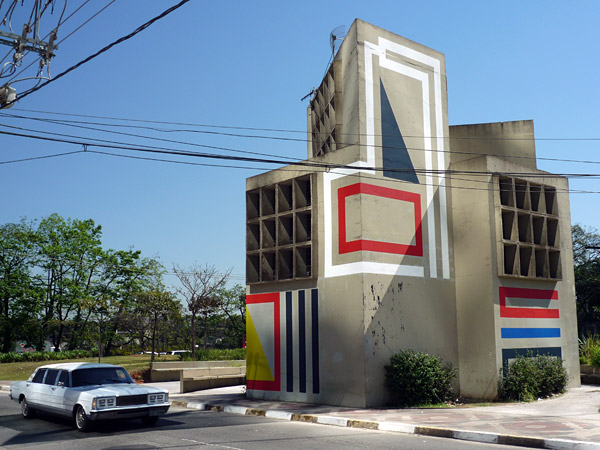
You visited a lot of cities and countries. Which places you visited were the most memorable?
I really like Latin America, I think so many authentic things are happening there, all the music I listen to is coming from Mexico, Brazil, Argentina or Peru. Some of my best memories are of the first projects I did in Monterrey, Mexico. The two month artistic residency I spent in Tampiquito in 2009 is still one of the best moments of my life. The last years I lived in Madrid building our Noviciado 9 studio were also epic! The first time I went to Warsaw during the summer of 2011, I had this amazing feeling that I was back to Madrid in 2001, People had told me that Polish are the Spaniards of Eastern Europe and I think in many ways this is true! Asia is crazy too, the urban environment is so saturated and it’s very inspiring when it comes to work in the street; it’s also interesting because the cities are almost void of any “urban art”.
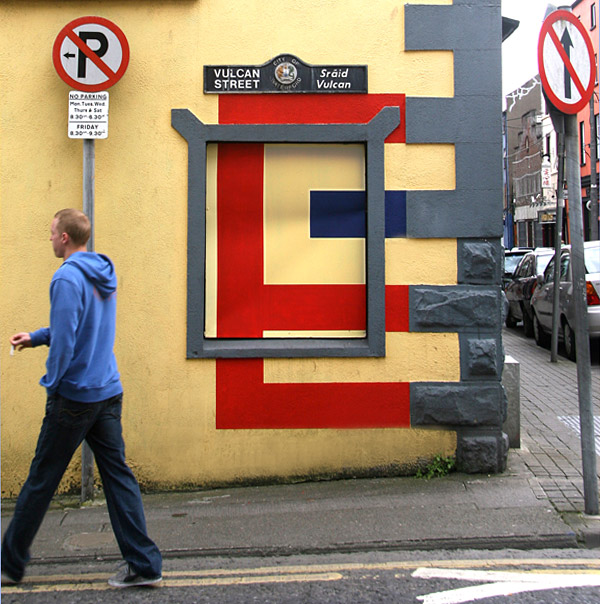 You started to work under the name of Eltono more than 10 years ago. Many artists when they start to work seriously with galleries don’t use their graffiti name any more. Have you ever thought about using your real name?
That’s a good question. Why should I change my name? Does it sound more serious to use your real name? I think the only thing that needs to be serious is the work of the artist. I am not a graffiti extremist but graffiti is where I come from and where I learnedto work in the street and appreciate urban spaces. Graffiti writers, for obvious reasons, paint using a pseudonym; my artistic activities are born using a pseudo and I don’t see any good reason to change this. Some people may know who I am because I have been painting in the street for 20 years andthis is the reason why I still use my tag and not my real name. My identity is not kept secret, it’s just not the name I use when I’m working. You wrote “to work seriously with galleries” in your question; for me there is no difference between street work and gallery work, both are equally valid ways to showcase art. I work very seriously when I am in the street and I also work very seriously with galleries and museums. When I started working for galleries, my work didn’t change in anyway. I think this is a major issue for artists painting in the street, and vindicating it. When they start having exhibitions, some of them just go and do a canvas version of their street work, brushing aside the city that used to be around the artwork and leaving it empty of any meaning. An artwork painted furtively in the street cannot be compared with an artwork painted comfortably in a studio. I suggest you read the clever essay Javier Abarca wrote about this topic in the monograph issued about the Deambular project: www.urbanario.es/en/monographs/monograph/art/eltono-deambular.
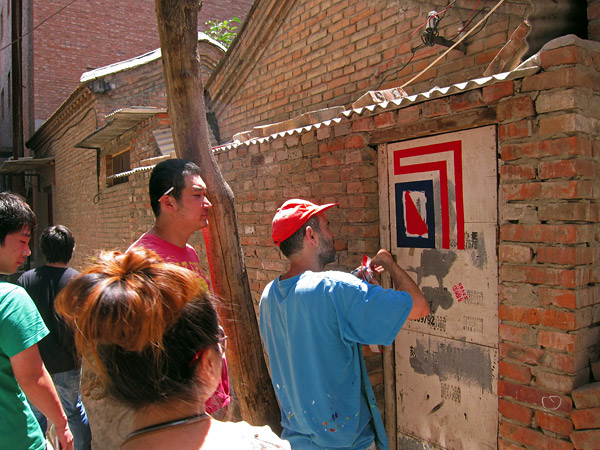
Is it easier to live of your art now that graffiti & street-art are fashionable?
Probably if your artistic production is fashionable. I don’t think mine is fashionable at all, I assume I would have noticed! I think my work lacks in the Mickey Mouse or Marilyn Monroe department, and also, I don’t use a projector! (I love the way my friend Tim summarized this sentiment in this post about my last work in China:
yeslifeblog.tumblr.com/page/2#33228538762).
 More seriously, it’s been more than 8 years now that I’m exclusively working as an artist and I never focused on saleability at the time of creating a piece; if somebody likes it and wants to buy it, awesome! If not, I don’t care. Anyways, it looks like society is already moving onto the next fashionable thing and “Street Art” will probably fall into nothing pretty soon… When you started your website in 2000 there was not only your own work but also street photos from the cities you visited. Are you still interested in what is happening in the streets?
Of course, I work in the street everyday, I spend a huge amount of time in the street, I only have a studio to steal wifi, do some chatting and store material, so naturally I am sensitive to everything that happens in the street. I am much more inspired today by the spontaneous conduct of everyday people than by other artists but, of course, I still notice every interventions done furtively in the street and one of the things I still most enjoy is a good silver-and-blackParisianBanlieue style piece. I usually get all my inspiration from the street but I also have a lot of admiration for consecrated artists like Francis Alÿs, Daniel Buren, Jacob Dahlgren and of course Sol LeWitt.

You made a few successful collaborations with MOMO. Are there other artists you would like to collaborate with?
When we work together MOMO and I, it’s just so easy and so much fun. We share similar ideas on experimentation and the use of arbitrariness. Of course, there are a lot of artists I’d like to collaborate with. In my opinion, for a long time, some of the most interesting approaches are coming from Northern Europe. First and foremost I enjoy collaborating with friends, the Equipo Plástico, the people from Noviciado 9 in Madrid…
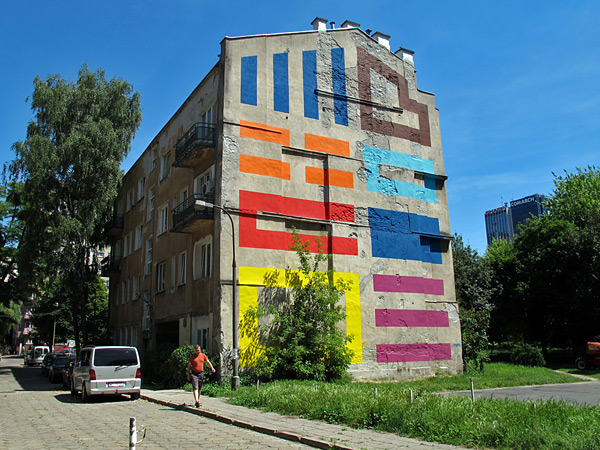 With Space Invader you are probably one of the only street-artist who still work on the same project for more than 10 years and whose work is still fresh and interesting. But are you sometimes bored of your experiments with colors and basic shapes and would like to try something totally different?
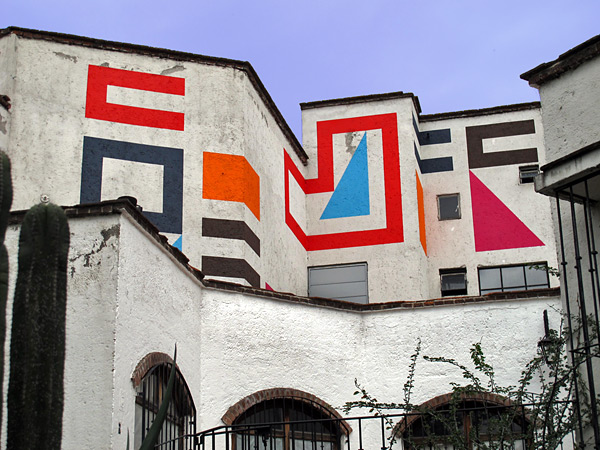
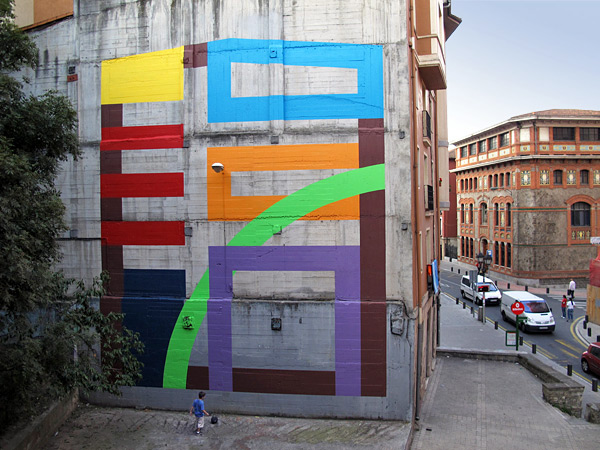
I try new things with every project and, at the same time, I always try to work around the same idea and push it further. I don’t think it would be exciting for me to work in thousands of directions at the same time. I prefer the exercise of working inside a defined frame, and from there trying new experiments. I think the exercise of renewing your work around the same base is very challenging. This is when you get a chance to dive deeper into your research, to try all the possibilities and to learn more. It is important for me to create a line, something personal. Just like graffiti, something recurrent and recognizable. It’s like research and I still have a lot of experimentation to do with geometric abstraction in the public space. Then, going out by night and doingpaintings with masking tape is still what I like the best. I still paint a lot of illegal pieces, I try to leave something everywhere I go, this is what graffiti is about and it’s during these moments that I learn the most about the street. I painted my last illegal piecein France two days ago.
 Where do you see yourself in 10 years?
Doing art freely in the street. Exploring deeper the line between public and private space. Involving the public in some weird experiments. Dancing Tecno Melody in Recife.
 www.eltono.com